Showing posts with label Puerto Rican Folklore. Show all posts

Friday, February 14, 2014

Juan Bobo or John the Boob

While I was doing research for the Chupacabra my grandfather, we call him Papa, told me that since I was looking up Puerto Rican  folklore I should look up Juan Bobo.  He wouldn't tell me any more than that.

It's taken me awhile to find stories and resources, especially in English.  Juan Bobo, or John the Boob in English, is the Puerto Rican equivalent of the German Foolish Hans.  I managed to find one of the more popular stories, Juan Bobo and the Pig.  In this tale Juan Bobo is left in charge of the house and animals while his mother goes off to the evening church service.  While she is away the pig begins to oink continuously, annoying Juan.  Juan determines that the pig must miss Mama so he tells the pig she may go to evening service but she must be dressed to go to church first!  So Juan dresses the pig in his mother's best dress and puts his mothers shoes, earrings and red lipstick on her as well.  Then Juan sends the pig to church.  Instead the pig runs off losing the shoes and ruining the dress in a mud puddle.  On her way back home, Juan's Mama finds the pig with the ruined dress and drags it back home where she gives

Juan a spanking for all his mischief.

I have found a couple of websites that have pictures of theatrical representations of Juan Bobo and his adventures.  Click here to see one example of Juan Bobo and the Big Cauldron and here is Juan Bobo in a more romantic moment, perhaps with the riddling princess.

Juan Bobo is not always a doltish character, sometimes he is a trickster.  in the tale of Juan bobo and the riddling Princess, Juan helps a horse in ned, solves the riddles of the riddling princess that many wiser men had failed to answer and wins the princess' hand in marriage, eventually becoming king himself! 


Resources:

Chardiet, Bernice. Juan Bobo and the Pig: A Puerto Rican Folktale Retold. New York: Walker and Company, 1973. Print.

Photos of a theatrical representation of Juan Bobo:
Juan Bobo and the Big Cauldron. http://paocotto.blogspot.com/2012/06/juan-bobo-y-el-caldero-grande.html

Juan Bobo kiss. https://teatrocirculowordpress.wordpress.com/image-gallery/juan-bobo-feb-07147/

Bobo Stories. http://610projbobo.blogspot.com/2007/11/juan-bobo-stories.html

Juan Bobo and the Riddling Princess: http://riddlingprinces610.blogspot.com/

Wikipedia. http://en.wikipedia.org/wiki/Juan_Bobo

Friday, November 29, 2013

El Chupacabra

One night when I was little my dad, my little sister and I were surfing the net and we came across the legend of El Chupacabra!  The stories of this vampire beast left me terrified to go up stairs in the dark.  But soon the chupacabra became a scary story to tell my friends until I relished retelling the legend of El Chupacabra!


Early depiction of El Chupacabra
El Chupacabra hails from Puerto Rico and since its introduction into popular culture in 1995 has migrated to Mexico, Main land U.S. A. in Florida and Texas and in other Spanish and Portuguese speaking countries.  There were reports all over Puerto Rico of goats and chickens found dead and drained of their blood by a mysterious vampire beast.  El chupacabra's name literally means "goat-sucker".

Before it was dubbed el chupacabra the vampire beast caused quite a panic in the towns of Morovis and Orocovis (my grandfather's hometown) in the spring of 1995 when farmers found their livestock dead with puncture wounds on their throat and their bodies apparently drained of all blood (Radford 7).  Benjamin Radford, author of Tracking the Chupacabra: The vampire beast in fact, fiction, and folklore, notes that vampires have always been an important aspect of Puerto Rican culture.  The Chupacabra has even been suspected of being an escaped experiment of the U. S. government, according to Radford, to many Latin Americans, "if America is the arrogant, paternalistic Dr. Frankenstein, the chupacabra is its unholy, blood thirsty progeny" (33).


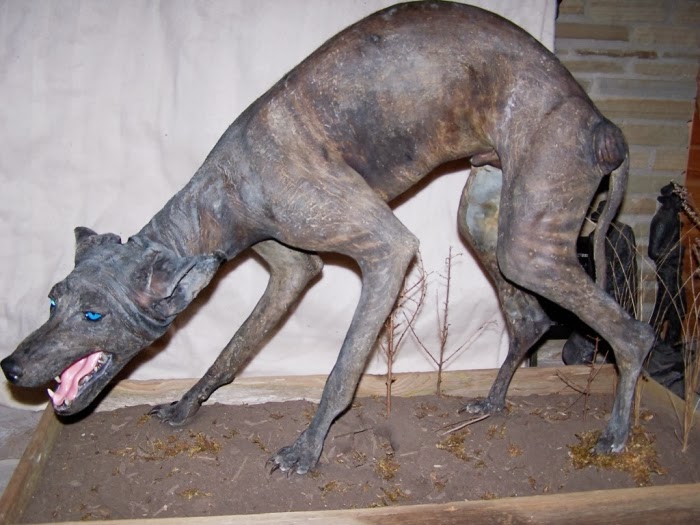
Cuero Chupacabra 2007
Try looking up a picture of el chupcabra and you'll find that apart from a few characteristics (long claws, powerful limbs and black or red eyes) no two pictures will look alike.  Eye-witness accounts of el chupacabra are many and varied and often quite sensationalized, some claim that the chupacabra stands on two legs and resembles an alien while other accounts describe it as resembling a dog with legs a bit shorter than the front legs, one account even reports that the creature has wings!  The most significant chupacabra sighting was that of Madelyne Tolentino of Canóvanas, P.R. in 1995.  In an interview Tolentino described the creature as walking on two feet and standing about four feet tall, "three long, skinny fingers. The arms were also very long" (plá).  The creatures skin had "some round things on its body and the region seemed ashen as if something had burned it right there" (plá).  Tolentino also claimed that a smell of sulfur accompanied the strange creature.  In Texas corpses of a dog-like creature were thought to be those of chupacabras that had been preying on local livestock.  the most notable is Dr. Phylis Canion's find in Cuero, TX in 2007.


Michael Lee 2007
Peter Dendle describes the Chupacabra as a "'goat-sucking' gremlin" (190).  I believe this description is misleading since gremlins are sentient beings with the interest and capability to mess with electronic and technological devices, a very specific attribute which is not a part of the chupacabra's repertoire.  However, el chupacabra is similar the gremlin, in that it is another example of a new mysterious creature, an evolution in folklore, emerging from our know-it-all technological age.  Since it's appearance in the mid '90s the chupacabra has continued to frighten, inspire and fascinate all.


Resources:

Davis, Mike. "Monsters and Messiahs". Grand Street. No. 61, All-American (Summer, 1997), pp. 34-38. JStor. Web. 2013 Nov. 29. http://www.jstor.org/stable/25000088

Dendle, Peter. "Cryptozoology in the Medieval and Modern Worlds". Folklore , Vol. 117, No. 2 (Aug., 2006), pp. 190-206. Web. 17 Sept. 2013. http://0-www.jstor.org.www.consuls.org/stable/30035486

"Documentaries continue to research DeWitt Blue Dog".  2013 Jul 7. Web. 2013 Nov 29. http://www.cuerorecord.com/articles/2013/07/17/documentaries-continue-research-dewitt-blue-dog

Plá, Lucy. "Los Chupacabras: The interview-Part 1". 1996 March 20. Web. 2013 Nov. 29. http://http://ufodigest.com/chupa.html

Radford, Benjamin. Tracking the Chupacabra: The vampire beast in fact, fiction, and folklore.  Albuquerque, New Mexico: University of New Mexico Press, 2011. Print.