Friday, November 29, 2013

El Chupacabra

One night when I was little my dad, my little sister and I were surfing the net and we came across the legend of El Chupacabra!  The stories of this vampire beast left me terrified to go up stairs in the dark.  But soon the chupacabra became a scary story to tell my friends until I relished retelling the legend of El Chupacabra!


Early depiction of El Chupacabra
El Chupacabra hails from Puerto Rico and since its introduction into popular culture in 1995 has migrated to Mexico, Main land U.S. A. in Florida and Texas and in other Spanish and Portuguese speaking countries.  There were reports all over Puerto Rico of goats and chickens found dead and drained of their blood by a mysterious vampire beast.  El chupacabra's name literally means "goat-sucker".

Before it was dubbed el chupacabra the vampire beast caused quite a panic in the towns of Morovis and Orocovis (my grandfather's hometown) in the spring of 1995 when farmers found their livestock dead with puncture wounds on their throat and their bodies apparently drained of all blood (Radford 7).  Benjamin Radford, author of Tracking the Chupacabra: The vampire beast in fact, fiction, and folklore, notes that vampires have always been an important aspect of Puerto Rican culture.  The Chupacabra has even been suspected of being an escaped experiment of the U. S. government, according to Radford, to many Latin Americans, "if America is the arrogant, paternalistic Dr. Frankenstein, the chupacabra is its unholy, blood thirsty progeny" (33).


Cuero Chupacabra 2007
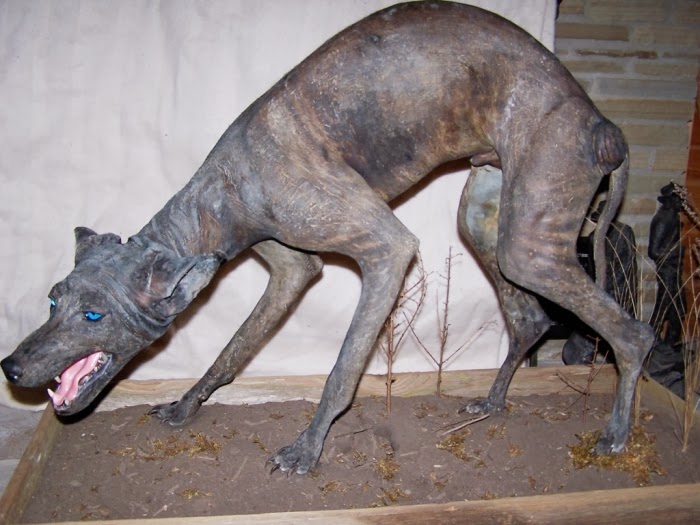
Try looking up a picture of el chupcabra and you'll find that apart from a few characteristics (long claws, powerful limbs and black or red eyes) no two pictures will look alike.  Eye-witness accounts of el chupacabra are many and varied and often quite sensationalized, some claim that the chupacabra stands on two legs and resembles an alien while other accounts describe it as resembling a dog with legs a bit shorter than the front legs, one account even reports that the creature has wings!  The most significant chupacabra sighting was that of Madelyne Tolentino of Canóvanas, P.R. in 1995.  In an interview Tolentino described the creature as walking on two feet and standing about four feet tall, "three long, skinny fingers. The arms were also very long" (plá).  The creatures skin had "some round things on its body and the region seemed ashen as if something had burned it right there" (plá).  Tolentino also claimed that a smell of sulfur accompanied the strange creature.  In Texas corpses of a dog-like creature were thought to be those of chupacabras that had been preying on local livestock.  the most notable is Dr. Phylis Canion's find in Cuero, TX in 2007.


Michael Lee 2007
Peter Dendle describes the Chupacabra as a "'goat-sucking' gremlin" (190).  I believe this description is misleading since gremlins are sentient beings with the interest and capability to mess with electronic and technological devices, a very specific attribute which is not a part of the chupacabra's repertoire.  However, el chupacabra is similar the gremlin, in that it is another example of a new mysterious creature, an evolution in folklore, emerging from our know-it-all technological age.  Since it's appearance in the mid '90s the chupacabra has continued to frighten, inspire and fascinate all.


Resources:

Davis, Mike. "Monsters and Messiahs". Grand Street. No. 61, All-American (Summer, 1997), pp. 34-38. JStor. Web. 2013 Nov. 29. http://www.jstor.org/stable/25000088

Dendle, Peter. "Cryptozoology in the Medieval and Modern Worlds". Folklore , Vol. 117, No. 2 (Aug., 2006), pp. 190-206. Web. 17 Sept. 2013. http://0-www.jstor.org.www.consuls.org/stable/30035486

"Documentaries continue to research DeWitt Blue Dog".  2013 Jul 7. Web. 2013 Nov 29. http://www.cuerorecord.com/articles/2013/07/17/documentaries-continue-research-dewitt-blue-dog

Plá, Lucy. "Los Chupacabras: The interview-Part 1". 1996 March 20. Web. 2013 Nov. 29. http://http://ufodigest.com/chupa.html

Radford, Benjamin. Tracking the Chupacabra: The vampire beast in fact, fiction, and folklore.  Albuquerque, New Mexico: University of New Mexico Press, 2011. Print.

Wednesday, November 13, 2013

Don't Lose Your Head!

      In 1820 Washington Irving publish the Legend of Sleepy Hollow in a book of collected works.  Since then the legend has been told and retold and made into several movies and is even the basis of a t.v. show.


      But long before Irving's Legend of Sleepy Hollow there was a similar headless phantom riding through the mists of Ireland known as the dullahan.  The dullahan is a herald that rides to claim the souls of those about to perish.  The dullahan may appear as a headless coachman driving a coach pulled by six headless horses or as a rider on a single horse holding his severed head aloft.  The dullahan's head is something terrible and amazing to behold, it has beady black eyes that dart about and the rotting flesh is stretched over the face like moldy glowing cheese.  That's right, it glows.  This glowing head acts as a lantern helping the dullahan to see those about to die over large distances. The dullahan will sometimes call out the name of the person about to die, similar to the bean-sidhe, although some tales suggest that if one covers their ears and doesn't hear the call death may pass them by.  Unlike the bean-sidhe, the dullahan doesn't favor specific families being an equal opportunity grim reaper.  The dullahan also has this nasty habit of tossing basins of blood at unwanted witnesses.

      There is a lot of mystery surrounding the dullahan's origins, though it is believed the he is the embodiment of an ancient Celtic god known as Crom Dubh or Black Crom, who was honored by King Tighermas with human sacrifices.  The favored method of sacrificing the victims?  Decapitation, of course.  The theory is that with the advent of Christianity and the decline of human sacrifices Crom Dubh took on the phantom form of the dullahan.  The dullahan has one weakness.  He seems to suffer from Aurophobia, the fear of gold.  In one tale, a man was traveling home one night when he heard the thumping of horses hooves on the road behind him.  When he turned he saw a great black horse galloping towards him, breathing sparks.  the rider was just as fearsome looking, carrying his severed glowing head aloft.  The terrified man began to run away. As he ran he dropped a gold coin.  The dullahan stopped short before the gold, gave a tremendous cry and vanished into the night.


Resources:

Haggarty, Bridget. "The Dullahan Ireland's Headless Horseman". Irish culture and customs. Web. 30 Oct. 2013. http://www.irishcultureandcustoms.com/ACalend/Dullahan.html

"Irish dullahan". Mystical Mythology. Web. 13 Nov. 2013. http://www.bellaterreno.com/art/irish/fairy/irishdullahan.aspx

"The Dullahan". Hidden Ireland. Web. 13 Nov. 2013. http://www.irelandseye.com/paddy3/preview.htm

Tuesday, November 12, 2013

Duck, Duck, Witch!


"Old Mother Goose,
      When she wanted to wander.
Would ride through the air
        On a very fine gander."
~J. E. Evans, Old Mother Goose c. 1820

Most of us are familiar with the nursery rhymes of Mother goose.  Thanks the Mother Goose and her rhymes we know that spiders do not make good lunch companions, we know it is possible for a dish to run away with a spoon in total disregard for the social conventions of other cutlery and gravity doesn't stop for babies in tree tops.  But who is this personage with these strange truisms for young children, this old lady in the witch hat that rides on a goose?

France, 1697.  Charles Perrault (remember him?) published his collection of stories Histoires ou Contes du Temps Passé.  The front piece of Perrault's collection of stories (which included "Cinderella", "Puss in Boots", "Sleeping Beauty" and "Little Red Riding Hood") featured an old lady telling stories to children with the engraving "contes de ma mère l'Oye", Tales of my Mother the .  Perrault was not the first to coin this term but when his tales became published in England they were called "Mother Goose's Tales" (Tsurumi).  In the 1760s John Newbery (You may have heard of the Newbery Medal for children's literature) published chap books for children and one of his publications was a collection of stories and rhymes entitled Mother Goose's Melody or Sonnets for the Cradle.
Harlequin and Mother Goose


But how did Mother Goose get the gander and the pointy hat, you may ask?  Let us time travel to the 1800s in Britain where pantomimes, also known as Harlequinades, were very popular.  These pantomimes were improvised stories that featured stock characters such as the mischievous Harlequin, the lovely Columbine, the fool Clown and the miserly old father of Columbine, Pantalone.  In 1806, a very sucessful pantomime called Harlequin and Mother Goose or The Golden Egg, opened up at the Theatre Royal on Drury Lane (You know, where the Muffin Man lives).  In this pantomime Mother Goose is featured as a witchy fairy godmother figure to the two lovers, whom she transforms into Harlequin and Columbine.  In Harlequin and Mother Goose Mother Goose raises a storm and rides on the back of a great gander that lays golden eggs, because she is one bad Mother - shut your mouth!- I was going to say Goose...


Resources:

Adams, Lois. "A Short Bio of Mother Goose".  Under the Green Willow. 30 March 2010 Web. 12 Nov. 2013. http://greenwillowblog.com/?p=994.

Delamar, Gloria T., "Just Who Was Mother Goose?". Mother Goose Society.  Web. 7 Nov. 2013. http://www.librarysupport.net/mothergoosesociety/who.html.

Tsurumi, Ryoji. "The Developement of Mother goose in Britain in the Nineteenth Century". Folklore, Vol. 101, No. 1 (1990). pp. 28 - 35. Web. 7 Nov. 2013. http://www.jstor.org/stable/1259881.

Zipes, Jack. When Dreams Came True: Classical Fairy Tales and Their Tradition. New York: Routledge, 1999. Print.

Sunday, November 3, 2013

Clippity-clop, Clippity-clop...

She calls herself Ide.  It means "Thirst". (Ironic, no?)

We're all familiar with vampires, those blood-draining fiends with an aversion to garlic and religious icons that can change into cats or bats and can only enter a house if invited.  My favorite vampire, or vampiress, is one that you've probably never heard of and she hails from Scotland, not Transylvania...

The glaistig ([glæstIg] glass-teeg), also known as the Green Lady, is a Scottish water spirit, who is infamous for luring unsuspecting male travelers from their path, seducing them and draining them of their blood.

On my last visit to N.Y.C., my friend and I went to a fashion exhibit at The Museum at the Fashion Institute of Technology. One of the dresses in particular caught my attention.  It was a full length dress, designed by Jean Paul Gaultier in 2002, gold and silver with a swirling teal skirt and designs printed on the fabric. But what really caught my attention, near the bottom of the dress was a print of a goat’s foot protruding from an illusory slit in the skirt so whoever wore this dress would look like she had goat feet.

“It’s a glaistig dress!” I whispered excitedly to my friend.

“What’s that?” she asked.  So I proceeded to explain, rather enthusiastically,that the glaistig abducts young men and drinks their blood until they are empty husks!  Needless to say my friend was rather taken aback. 

However, like most water spirits the glaistig is alternately evil and good.  The glaistig, similar to the faun, is the top half of a woman with the back legs of a goat which she hides beneath the long skirt of her green dress.  If treated well with an offering of milk the glaistig will watch out for herds of sheep and goats as well as minding the children of shepherds and goatherds and even herding livestock for farmers.  On the flip side the glaistig ranges between a mischief that throws rocks in the paths of unsuspecting travelers to downright vicious if she is wronged.  I wonder what inspired Gaultier to put a goat’s foot on this dress


Resources:
F. I. T. (The Glaistig Dress)
Froud, Brian and Alan Lee. Faeries. Abrams: New York, 2002. Print.
Mysterious Britain & Ireland
Paciorek, Andrew L., Night Terrors & Lovers
Wikipedia